
Date: Wednesday, May 6, 2026
Time: 11:40 am
Place: Aula 1.A1 (Faculty of Science & Technology, Leioa, UPV/EHU)
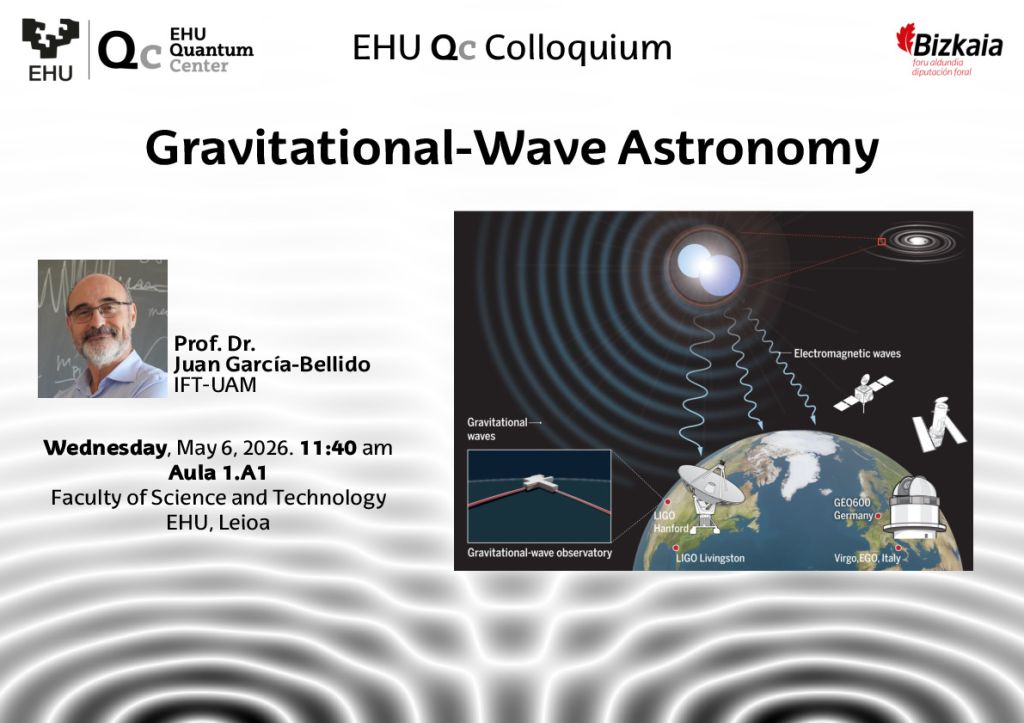
Title: Gravitational-Wave Astronomy
Speaker: Prof. Dr. Juan García-Bellido (IFT-UAM Madrid)
Abstract:
Ten years ago, a laser interferometer detected, for the first time in history, gravitational waves originating from a distant cataclysmic event associated with the merger of two massive black holes, GW150914. The energy emitted in just a few milliseconds by that single event was equivalent to 50 times the power of all the stars in the observable universe combined. Today, we have detected around 300 events similar to GW150914, and a new era has just begun: the era of Gravitational-Wave Astronomy. With the help of a network of laser interferometers in the U.S., Europe, Japan, and India, we can localize sources within one square degree in the sky, at distances of billions of light-years. These exquisite and delicate detectors open a new window onto the universe, where space-time waves, rather than light (electromagnetic waves), provide us with complementary information and help us understand the origin and evolution of our universe. I will review recent gravitational-wave detections and how their properties are challenging our understanding of the nature of dark matter and the current rate of expansion of the universe.
Short Bio:
Juan García-Bellido Capdevila is Full Professor of Theoretical Physics at the Autonomous University of Madrid and a researcher at the Institute of Theoretical Physics (UAM-CSIC). He is an internationally renowned theoretical cosmologist and the author of more than six hundred research papers published in the leading journals in the field, with over 86,000 citations (h-index 137). He has worked at CERN, Imperial College London, and Stanford University.
His research spans an enormous range of cosmological phenomena, from the origin of the Universe in terms of the paradigm of Cosmic Inflation to the formation of galaxies and other large-scale structures. He is currently studying the nature of Dark Matter in terms of Primordial Black Holes and Dark Energy in the form of Relativistic Entropic Acceleration. He is an active member of numerous international collaborations such as the “Dark Energy Survey”, “PAUS”, “LIGO-Virgo-KAGRA”, “DESI”, “LSST”, and “Einstein Telescope”, as well as ESA missions such as “Euclid” and “LISA”.
He has served as a member of the University Senate and Governing Council of UAM, as a representative of academic staff on the Council’s Research Committee, and as a member of the executive board of the IFT, serving as Director of the Department of Phenomenology and Cosmology. As Principal Investigator, he has coordinated more than 30 research projects and supervised 18 PhD theses.
He has been the Spanish representative on the International Committee of the Particle Astrophysics and Cosmology Theory panel of ApPEC and on the International Committee of ASTRONET for the preparation of the report Science Vision for European Astronomy 2015–2025, as well as a member of the National Committee of the Astronomical Infrastructure Network for the preparation of the Decadal Survey of Spanish Cosmology for 2015–2025. He is a member of the Royal Spanish Society of Physics and the Gadea Foundation for Science, and a Corresponding Member of the Royal Academy of Sciences of Spain. In 2025, he was awarded the Blas Cabrera National Research Award.