


1. Neutrino signals from merging stars
Most of the stars in our Universe are found in binary systems, and many of them should merge. This phase is mysterious, because any signal is shielded by the stellar envelopes. But it is key to understand, among others, supernovae or the observed gravitational-wave sources. If one of the stars is a white dwarf, its strong gravitational field is expected to heat infalling gas to high temperatures where thermonuclear reactions should take place. These reactions can emit neutrinos, feebly-interacting particles that would escape and lead to a direct signal of this important but poorly understood astrophysical phenomenon. In this project, the student will compute the neutrino signal from such a system, and understand if it is detectable or not.

2. Designing robust two-qubit gates
Quantum computers work by carefully controlling small quantum systems called qubits, but these systems are extremely sensitive to noise from their environment. In this project, we will study how to make a key operation in quantum computing — a two-qubit entangling gate — more reliable and resistant to noise. The idea is to couple two qubits through a shared quantum oscillator (such as a resonator or vibrational mode) in a way that reduces unwanted energy loss and protects the qubits from disturbances. We will develop a simplified mathematical model that describes how this interaction works, identify the main sources of error (like random fluctuations and residual motion in the oscillator), and test the gate’s performance using numerical simulations. If time permits, we will discuss how this method could be implemented in real systems such as semiconductor spin qubits or trapped ions. The project combines theoretical modeling and computational work and is well suited for an undergraduate student interested in quantum physics and quantum computing.
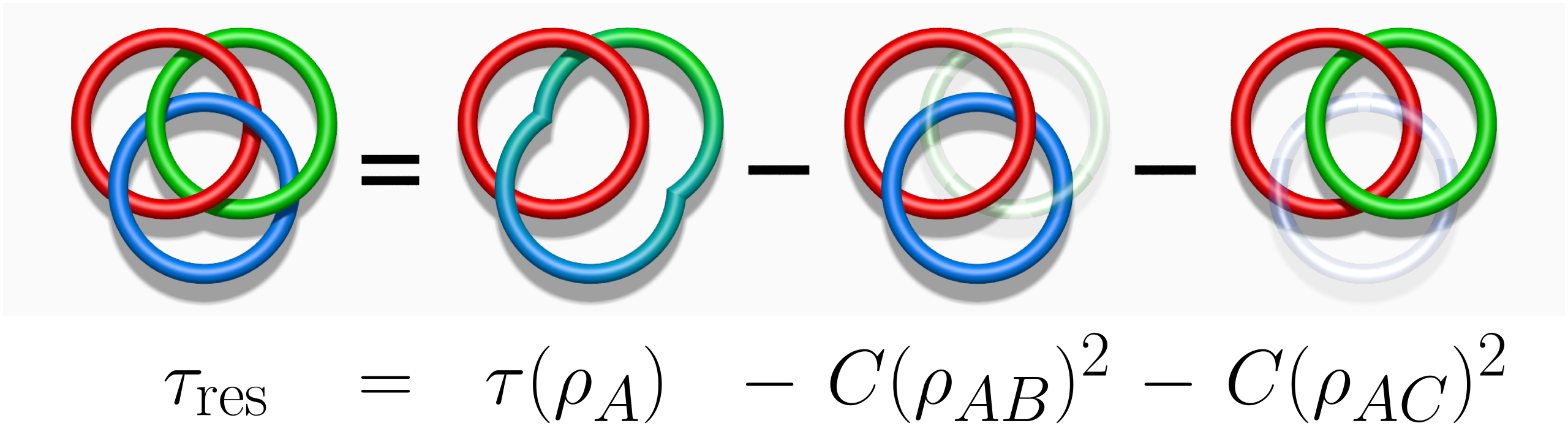
3. Understanding the monogamy of qubit entanglement
Entanglement is the primary type of correlation that differentiates quantum from classical systems. In systems with more than two parties there may occur different types of entanglement that often are difficult to quantify. For many-qubit states it is known that entanglement contributions can be added up and fulfill certain inequalities, or even equalities (see the illustration of an equality for three-qubit states above), which are called "monogamy relations". Only few such relations are currently known. Understanding their "inner workings" is essential for quantum information theory and many-body quantum physics alike. In this project we will study the oldest and most famous of these monogamy constraints, the Osborne-Verstraete-Wootters inequality. While there exists a formal proof, there is no intuitive understanding of the structure of the inequality. By numerically investigating the generalized Bloch vector of quantum states of a few qubits we aim to shed new light on this longstanding problem.

4. Anomalous collective modes in Quantum Materials
Quantum materials can host emergent phenomena when electrons collectively behave as new “particle-like” excitations. Remarkably, some of these modes resemble axions or dilatons—hypothetical particles discussed in particle physics and cosmology. The student will study how such modes can arise from violations of classical symmetries by quantum effects, known as quantum anomalies. We will start from simple one-dimensional models, where the key ideas are especially transparent and many results can be obtained analytically. The goal is to identify when these modes appear and what their experimental fingerprints are. This project offers a concrete entry point into modern theory at the crossroads of condensed matter, high-energy, and nuclear physics, setting the stage for extensions to realistic quantum materials.

5. Quantum decay of oscillons
Oscillons are localized, spherically symmetric, long-lived oscillatory solutions of nonlinear classical field equations that can naturally form in the Early Universe. Because their properties may leave observable imprints, they offer a potential window into the physics driving the first few instances of our universe. Although they are quasi-stable at the classical level, quantum effects can significantly alter their decay rates and lifetimes, thereby affecting cosmological predictions. This project aims to investigate the decay and stability of realistic oscillons by combining 3+1 dimensional numerical simulations of classical field theories with an analysis of quantum corrections to their dynamics.
